
“What if we could catch mosquitoes before they ever take flight?”
It was this question—asked by someone tired of hopelessly swatting at flying mosquitoes—that gave birth to Guppytrap.
To be effective and cost-efficient, it’s best to strike at the source of the problem: our flower pots, the favorite breeding ground of urban mosquitoes.
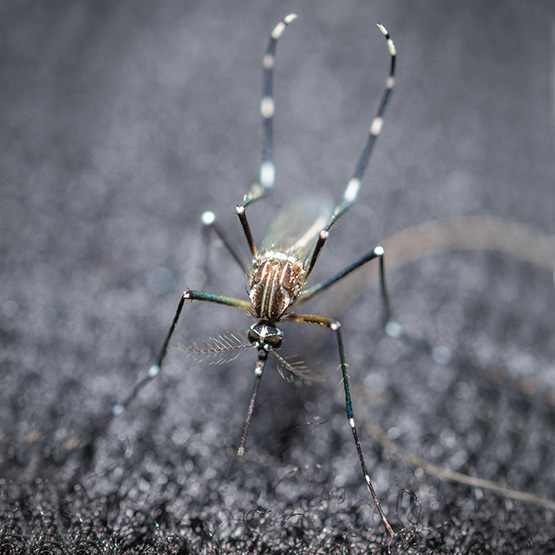
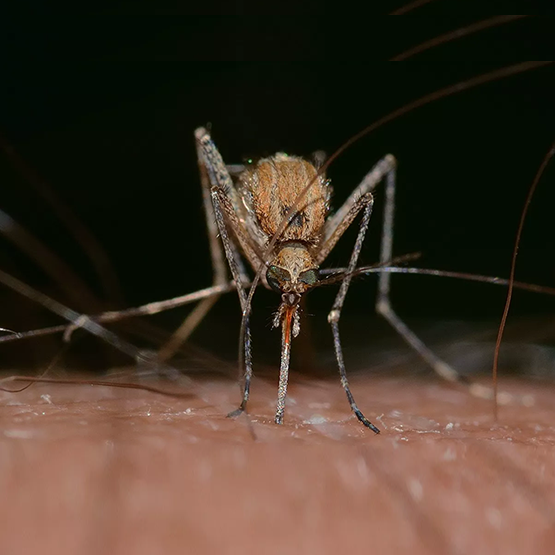
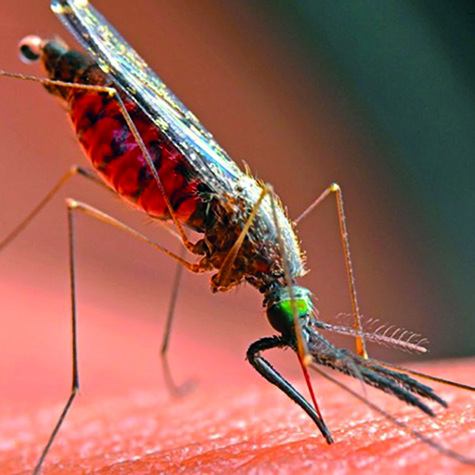
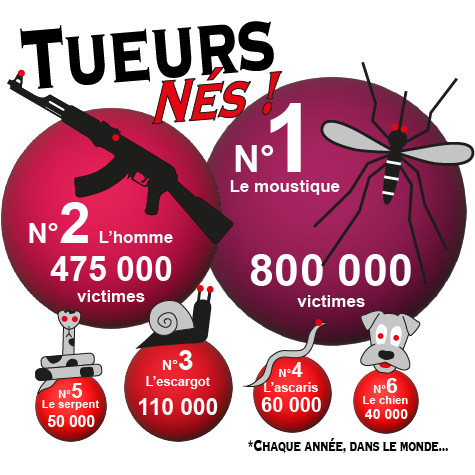
Mosquitoes: the #1 killer of humans for centuries!
What used to be a simple nuisance has become a real threat in Europe over the past several years, as mosquitoes can transmit viruses such as dengue, Zika, and chikungunya (to name just a few).
Traditional chemical solutions (insecticides, repellents) pollute the environment and are becoming increasingly problematic, because they lose effectiveness year after year as mosquitoes adapt.
After 2.8 million years of mosquito dominance, human ingenuity has finally produced a simple, long-lasting, clean way to fight this scourge—without chemicals, without energy, and without bait.
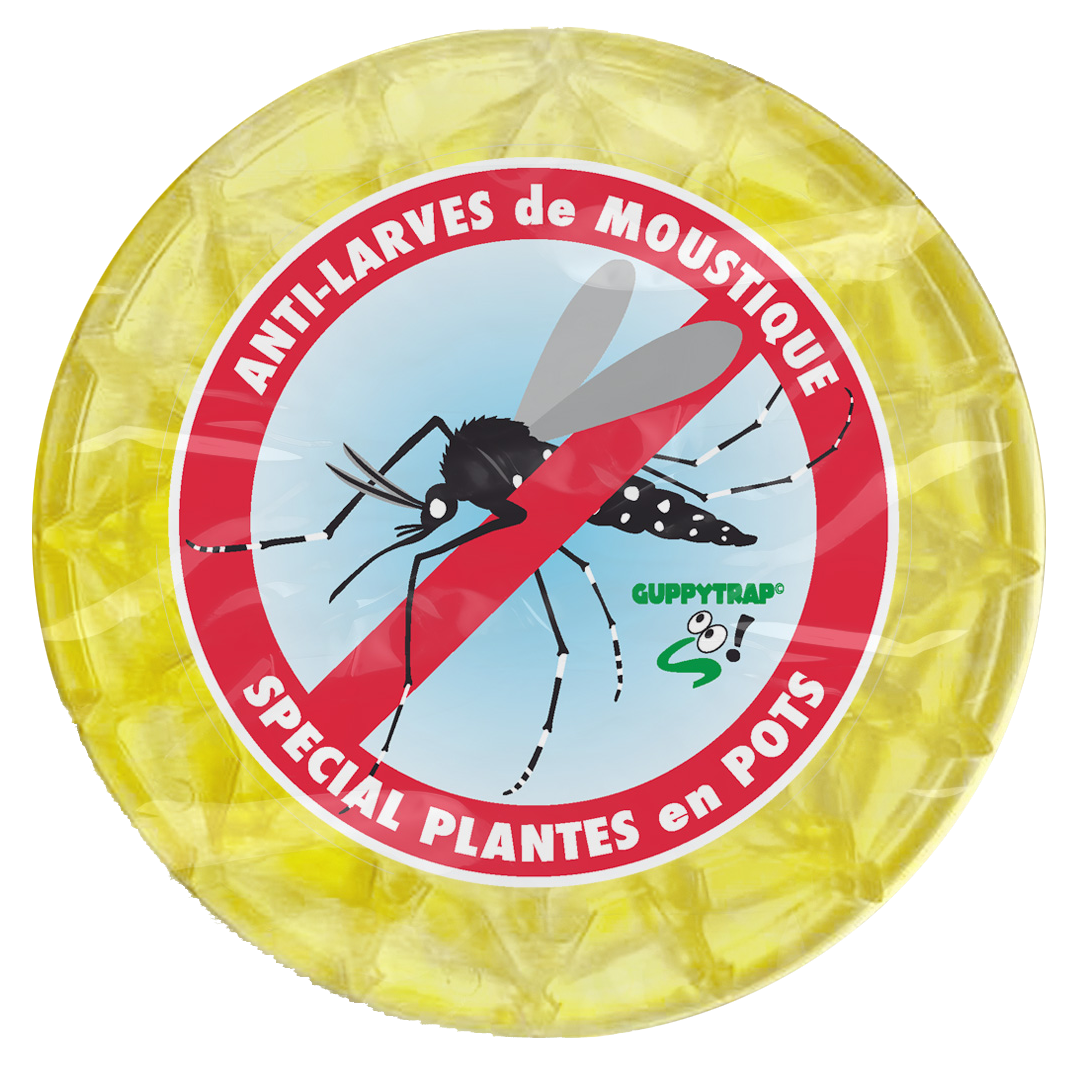
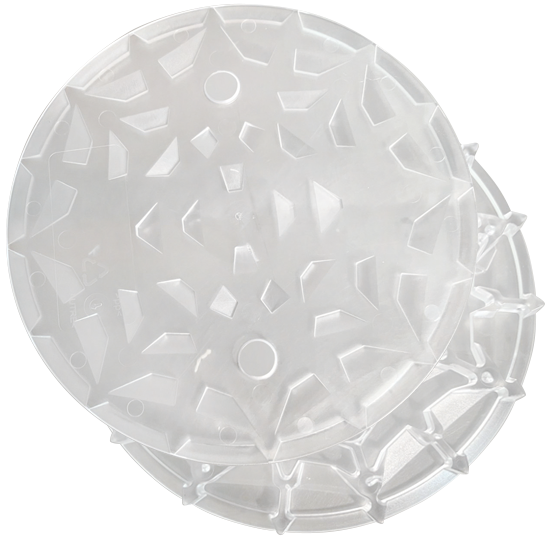
Inspired by the principle of an aquatic fish trap, GUPPYTRAP was developed in the tropics after 8 years of research. Since then, it has been scientifically tested and validated in numerous laboratories around the world.
Patented internationally, GUPPYTRAP is now mass-produced in our French factory in Saint-Étienne. It’s available for purchase on this website, and through many international distributors.

“It’s not magic—it’s science!”
6 in
In diameter
0.35 in
Thick
26 g
Unbreakable
97%
proven effectiveness*
92 countries
Patented in
5 seconds to turn your plants into deadly mosquito traps…
1) Fill your saucer with water.
2) Fully submerge the maze section (the base of the trap).
3) Remove any air bubbles that may be stuck to it.
4) Place the lid under water, making sure no air is trapped inside.
5) Check the water level and top up if needed.
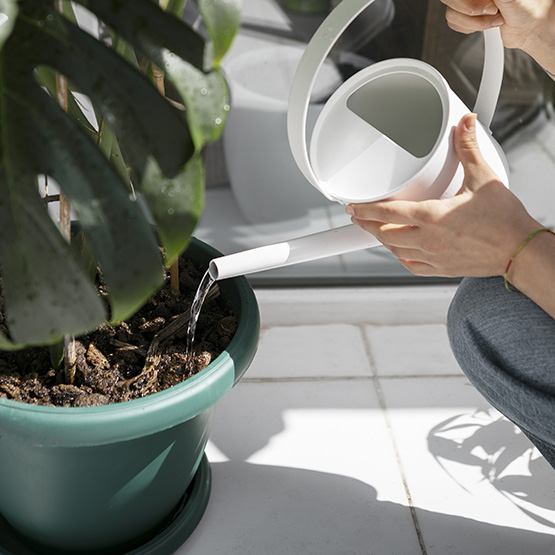
Water your plant regularly, making sure the trap always stays fully underwater with no air inside. If air gets into the trap, simply repeat the full setup process.

The trap works like a fish trap: easy to get in, impossible to get back out to breathe.
Studies show that flower pot saucers are among the main mosquito breeding sites in urban areas. The stagnant water that collects under our plants is a prime place for reproduction.
No bait is needed: organic matter from the soil and natural residues from the plant diffuse into the water, making it an ideal spot—through the eyes of a female mosquito—for laying eggs.
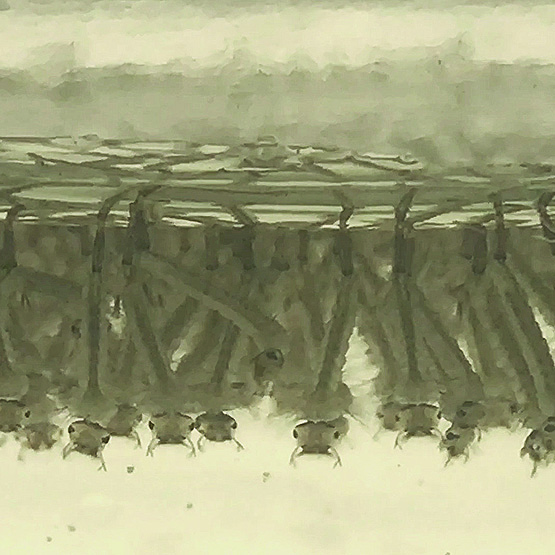
Once they hatch, the tiny larvae live there until the moment they try to hide or feed at the bottom of the saucer. Trapped in the maze and unable to return to the surface to breathe every couple of hours, they drown. As they decompose, the water becomes even more attractive.
The stagnant water in your flower pot becomes the bait, the nursery, and the lethal trap that suffocates and drowns the mosquito larvae born there—every time.
That’s how your favorite plants become larva traps—your everyday allies against mosquitoes: year-round in the tropics, and from spring through fall in Europe.
Here’s an uncut live video of Guppytrap in action, showing exactly how it works—and how effective it is.
(It’s long, but guaranteed with no editing or tricks!)
“If you use it wrong, even the best fishing rod in the world won’t make you a fisherman!
Even though it’s child’s play, you still need to use Guppytrap correctly for it to be effective.”
HIGH-PERFORMANCE
Over 97% proven effectiveness,
tested and certified by our partner laboratories.*
SAFE
No chemicals or additives,
safe for kids, pets, plants — and you.
DISCREET
Hidden beneath the surface,
it won’t change the look of your space.
TARGETED
Works right where mosquitoes are born,
and only kills mosquito larvae.
EASY
Quick, simple setup,
with nothing to do beyond normal plant watering.
COST-EFFECTIVE
One-time purchase,
with no refills or consumables needed.
PATENTED
A low-tech innovation protected by French patent
FR-3076688 and its international extensions.
ECO-FRIENDLY
Zero energy, zero chemicals,
100% environmentally friendly.
*In under 48 hours ARS Guadeloupe test (05/02/2023)
2022
Presented at the
Transtech “Tremplin” (2022)
2022
Eco-Innovative Project of the Year
Sustainable Development Pro Meetup
2023
Silver Medal
International Lépine Competition Paris
2024
Silver Medal
International Exhibition of Inventions of Geneva
“Indoors or outdoors, well-placed plants that are watered properly actively help reduce mosquito breeding all season long.”
Your Questions, Our Answers
Exactly—that’s the point: it didn’t exist yet. Innovation takes time, especially when it’s eco-friendly. It took 8 years of R&D in Guadeloupe to develop this patented system.
Our perspective as designers and technicians brought a fresh angle to mosquito control—an area usually left to biologists, chemists, and entomologists. Guppytrap is first and foremost a fluid-mechanics solution before it’s a biological one. It took skills that aren’t typically in the field to arrive at something this simple.
And trust us—we understand the skepticism.
Every summer, we’re flooded with “mosquito gadgets,” and even phone apps that claim to repel them… it’s hard not to doubt.
But Guppytrap isn’t a gimmick—it’s a tool. A control tool that has been tested and validated by multiple laboratories using rigorous protocols. The 97% effectiveness in under 48 hours isn’t a marketing promise—it’s a measured result, then certified by a French government agency.
After that, like any tool, the key is simple: use it correctly and follow the setup and usage instructions. And that part is up to each user.
First, choose a plant that likes water (a gardener’s advice can really help if you’re just getting started), a pot with a base diameter between 10 and 16 cm, and a smooth-bottom saucer large enough for the trap to sit flat.
For placement, avoid wind and direct sun—closer to the ground is better than up high. Mosquitoes prefer cool, shaded areas and don’t fly very high.
Guppytrap isn’t affected by rain, so indoor or outdoor use is fine. And if your yard is large, keep in mind that a mosquito typically has a 100–150 meter range for laying eggs (and biting too). That’s why a good starting setup is often one pot placed strategically at each corner of the property. During the “detection” phase, don’t hesitate to try a few different locations to find the best hot spots—every environment is different, so you have to think like a mosquito trapper.
Never forget: no water, no eggs. So water generously and often to keep the trap fully submerged. In very hot weather (high evaporation), an automatic watering nozzle aimed at a trapped saucer is also an excellent solution.
Once everything is in place, your traps only need a quick check and an occasional rinse under the tap about once a month—year-round in the tropics, and from spring through fall in Europe.
It becomes a positive cycle: natural residues from the potted plant and from decomposing larvae keep the water nutrient-rich and attractive, acting as the “bait” for a low-maintenance egg-laying trap that keeps killing to reduce breeding.
That’s how your favorite plants become your everyday allies against mosquitoes—for many years to come.
To explain our principle, it’s enough to think of its similarity to the fish traps used by fishermen. A fish trap doesn’t need advanced technology to work—and fish don’t develop “resistance” to an active ingredient… because there isn’t one.
Each internal cell of the trap is a tiny 3D fish trap, based on a principle as old as time. If a fish still can’t escape one after thousands of years of evolution, it’s safe to assume Guppytrap will keep working on mosquito larvae for many years to come.
Female mosquitoes need stagnant water to lay their eggs—and that’s exactly what the water in our plant saucers provides. Once the eggs are laid, the larvae hatch and, being instinctively cautious, they try to hide from light and ground vibrations or feed at the bottom of the saucer. In doing so, they enter the trap and are forced deeper and deeper until they end up trapped at the end of the maze. To survive, they must reach the surface to breathe every couple of hours—but they can no longer make it back up. They die by suffocation.
Simple—but brutally effective.
Yes—GuppyTrap is a control tool, not a magic product.
Even before installation, you should eliminate other sources of stagnant water around your home. That’s essential, so female mosquitoes lay eggs in your trap instead of somewhere else.
Once your traps are installed:
1) Always keep a minimum water level above the trap. No water means no egg-laying—so no hatching, no larvae… and therefore no trapped larvae.
2) Check regularly that the disk is properly in place and that it isn’t full of air. Larvae move only by swimming in water. Small air bubbles don’t matter, but a chamber filled with air becomes a barrier they can’t cross, which can stop or slow their progress through the trap.
3) Every 1–2 months, remove dead larvae by simply rinsing the trap with clean water. With this basic maintenance, it will last for many seasons—it’s a long-term investment.
A single water source is all a mosquito needs to lay hundreds of eggs, so control has to be thorough to be effective.
That said, there’s no need to place a Guppytrap under every pot. Mosquitoes can travel up to about 150 meters to find a suitable water source—so they’ll come to your trapped saucers. Just make sure the other saucers in your garden stay dry. Some customers even drill a small hole in the bottom of non-equipped saucers as a precaution, but it’s up to you to manage your garden and eliminate any potential “breeding sites.”
Ideally, the only stagnant water you have should be your trapped saucers—so GUPPYTRAP can do its job at maximum effectiveness.
“Frequently copied, never matched!” All official GuppyTrap products carry our exclusive hexagon-shaped stamp. For maximum safety, quality, and performance, buy only on guppytrap.com or from an authorized reseller.
A traditional Guadeloupe fish trap with its distinctive shape—the inspiration behind our hexagonal stamp…
Absolutely not. GuppyTrap is a purely mechanical device made from clear, rot-proof plastic. No chemicals, no harmful substances. The water will continue to feed your plants normally, and there’s no issue if a bird—or your cat—drinks from it.
Yes—anywhere there are mosquitoes and potted plants with saucers. It’s especially effective in tropical regions, where mosquitoes are active year-round.
That said, for the more specialized readers: GUPPYTRAP primarily targets mosquitoes in the Aedes genus (aegypti and albopictus—the well-known tiger mosquito). These are urban mosquitoes that particularly love flower pot saucers, but also poorly installed gutters, storm-water drains, stagnant water caused by small leaks, and sometimes even refrigerator drip trays. So keep your eyes open at home—mosquitoes are incredibly good at finding standing water you wouldn’t even suspect!
Mosquitoes in the Culex genus, which generally need more water to swim, are also sometimes attracted to a water-filled GUPPYTRAP, especially if your environment is dry—because life always finds a way, and mosquitoes adapt…
What’s the lifespan of a GUPPYTRAP trap?
Hard to say—because it’s made from virtually unbreakable clear polycarbonate, similar to what’s used for riot shields. Chances are your great-grandkids will still be using it long after you… As long as houseplants exist, GUPPYTRAP will keep killing mosquitoes.
Don’t worry about mosquito larvae in a container that overflows. Nature is well designed—they know how to hide at the bottom as soon as the first raindrops hit (and they’ll still enter the trap when they move around…). So yes, you can absolutely use GUPPYTRAP outdoors—rain will simply top the water level up for you.
If you can’t find an answer to your question…
Thank you !
“With all the ‘anti-mosquito’ gadgets that pop up every summer, doubt is understandable. But our method is based on a very simple, highly effective principle.”
Protect your home from mosquitoes
Official patented Guppytrap products. Made in our factory in Saint-Étienne, France. Worldwide shipping.
“Lotus“ saucer
-
NEW FOR 2026!
-
Our new specially designed
LOTUS saucer,
with a lowered base
for optimum efficiency!
-
Available in multiple colors
-
Learn more at :
https://www.youtube.com/watch?v=4BRTuYTaTlo
Guppytrap Trap Only
-
BEST SELLER!
-
The GUPPYTRAP on its own
Internationally patented trap
Diameter: 15 cm / Thickness: 9 mm
-
Compatible with the Lotus saucer
and all flat-bottom saucers.
-
Premium version
High-strength polycarbonate
Anti-UV yellow color
The 5 pack
-
FOR PROFESSIONALS!
-
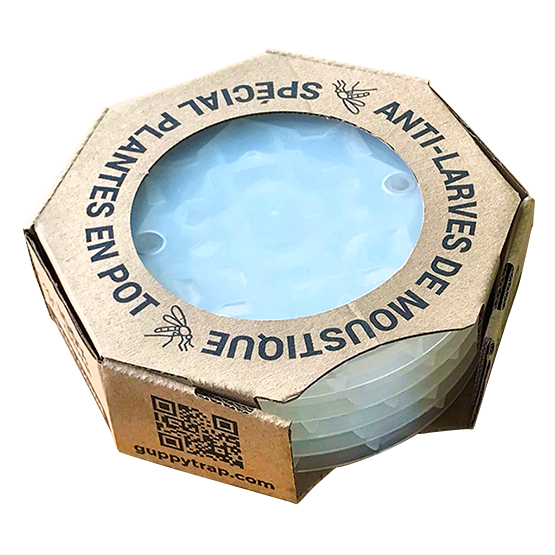
Pack of 5 GUPPYTRAP
Even more cost-effective
-
Premium polycarbonate version
High resistance
Anti-UV yellow
-
Professional packaging
Online purchase via our partner Plastiroll: ordering, payment, shipping, and customer support are handled by Plastiroll.
“Guppytrap is the most natural way to fight mosquito breeding.”
GUPPYTRAP
The natural, patented
solution against mosquitoes.
French patent FR3076688
International patents pending